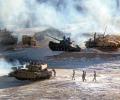
There was no visible forward movement in disengagement of troops in the remaining friction points as the Chinese side did not show flexibility in their approach on it at the 11th round of military talks.
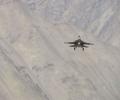
The frequency of day and night operations by frontline fighter jets is a signal that India will continue to put pressure on China until the status quo ante is restored in all the areas in eastern Ladakh including Pangong Tso, Gogra and Hot Springs, government sources said.
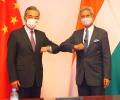
Jaishankar said full restoration and maintenance of peace and tranquillity in border areas was essential for the development of the bilateral ties.

Union minister Kiren Rijiju on Friday said he interacted with soldiers of China's People's Liberation Army along the Sino-Indian border near Tawang during a visit to an Indian Army post on Diwali.

Outgoing Indian envoy to China Vikram Misri on Monday had a virtual farewell call on Chinese Foreign Minister Wang Yi during which he said that "certain challenges" had overpowered the vast opportunities in the bilateral ties last year and hoped that with continued communication the two sides would be able to resolve the current difficulties.
He said that the two nations will have issues in the foreseeable future. However, there are ways of addressing those issues and what happened in 2020 was not the way to address those issues.
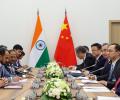
According to informed sources, Doval will arrive in Beijing on Tuesday to attend the crucial talks, which were expected to provide a way forward for the two countries to normalise the relations.
The 11th round of the Corps Commander-level talks began at around 10.30 am at the Chushul border point on the Indian side of the Line of Actual Control (LAC) in eastern Ladakh, they said.

The Indian Army on Friday strongly insisted on early disengagement of troops by China from all the friction points in eastern Ladakh at the eighth round of corps commander-level talks between the two sides that primarily focused on a roadmap for restoration of peace and tranquillity in the region, according to people familiar with the developments.

Qin, who is visiting New Delhi to attend the G20 Foreign Ministers meeting on Thursday, is expected to meet Jaishankar on its sidelines though the foreign ministry here is tight-lipped about it.

The current geopolitical situation necessitates the Indian Air Force to prepare for intense and small duration operations at a short notice, Chief of Air Staff Air Chief Marshal VR Chaudhari said on Thursday.

Amid tensions over build-up by the Chinese across the Line of Actual Control (LAC) in Eastern Ladakh and reluctance to resolve remaining issues between the two countries, Indian Air Force (IAF) chief Air Chief Marshal VR Chaudhari is visiting forward areas in Ladakh to review the operational preparedness of troops deployed there.
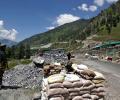
The Indian troops deployed there are mentally prepared for tackling the weather and terrain. In contrast, the Chinese troops deployed along the Line of Actual Control (LAC) are not used to these conditions as they have been brought from mainland China and are not accustomed to high altitude extreme cold weather conditions.
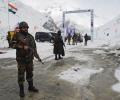
Indian and Chinese militaries on Monday moved back their frontline troops to the rear locations from the face-off site of Patrolling Point 15 in the Gogra-Hotsprings area in eastern Ladakh and dismantled temporary infrastructure there as part of a five-day disengagement process.
Singh said a meeting between senior Indian and Chinese military leaders has been scheduled for June 6 even as he asserted that India is not going to back off from its position. Asked about the current situation in sensitive areas in eastern Ladakh, he said Chinese have come up to what they claim is their territory while Indians believed it is theirs.

The army made the comments as part of a statement trashing a media report that said the Chinese military has again crossed the Line of Actual Control in eastern Ladakh at several places and that there has been at least one incident of clash between the two sides.

The sources also said both the Indian and Chinese troops are firmly holding on to their respective positions at the Line of Actual Control.
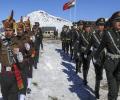
India on Monday announced it has reached an agreement with China on patrolling along the Line of Actual Control (LAC) in eastern Ladakh, in a major breakthrough in ending the over four-year-long military standoff ahead of a likely meeting between Prime Minister Narendra Modi and Chinese President Xi Jinping in Russia this week.

Ministry of External Affairs (MEA) spokesperson Arindam Bagchi said China continues to deploy a large number of troops and armaments in the border areas and it was in response to Chinese actions that the Indian armed forces had to make appropriate counter deployments.

A broad consensus has been achieved by India and China on restoring the 'ground situation' along the Line of Actual Control (LAC) pursuant to talks, including for patrolling and grazing cattle in the traditional areas, Defence Minister Rajnath Singh said on Thursday.
Asked about the reports of the troops on both sides disengaging and moving back to their previous positions, Chinese foreign ministry spokesperson Hua Chunying told a media briefing in Beijing that both sides are taking steps to ease the situation along the borders.

'The PLA has continued to do exercises and drills and recently carried out air exercises with fighter jets.'
"On the border issue, China always maintains that we should follow through on treaties and agreements we signed and we jointly uphold peace and tranquility at the border region," Foreign Ministry spokesman Wang Wenbin said while responding to Jaishankar's remarks.
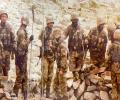
The Chinese numbers had surged significantly during the summer season as they brought in a large number of troops for summer training. They have now gone back to their rear locations.

India and China have held their first diplomatic talks since withdrawing troops from two face-off points in eastern Ladakh, reflecting on the lessons learned from the border row to prevent future incidents. The two sides agreed to maintain peace and tranquillity in border areas, prepare for the next meeting of Special Representatives on the boundary question, and highlighted the importance of regular exchanges and contacts at diplomatic and military levels. The talks come after the completion of the disengagement process from the last two friction points, following an agreement finalized in October 2022.
China and India were able to "reduce differences" and build "some consensus" on disengaging troops from friction points to end the standoff in eastern Ladakh and agreed to maintain dialogue to reach a resolution acceptable to both sides at an "early date", the Chinese defence ministry said on Thursday.
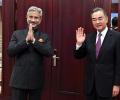
If the visit takes place, it will be the first trip by a senior Chinese leader to India after the eastern Ladakh standoff between the two countries began in May 2020.
"I still have not heard a credible explanation as to why they chose to bring that size of forces to that sector of our border. Now, if peace and tranquility is disturbed and attempts are being made to change the LAC status quo unilaterally and large forces are brought to the border in contravention of written agreements, then obviously the relationship will be impacted," he said.
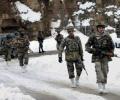
The Indian Army is effecting a major "reorientation" and "rebalancing" of its troops in the strategically sensitive areas along the Line of Actual Control (LAC) in Arunachal Pradesh, with a top general saying its overall combat readiness in the region is of a "very high order."
It will be the third road link to Ladakh after the other two roads: the Manali-Leh road and Srinagar-Leh highway. The work on reopening an alternative road to Ladakh from Himachal Pradesh has been expedited as it is a strategically key road, said an official on condition of anonymity, adding the project is expected to be completed by the end of 2022.
Gen Wang is the fourth commander to head the Western Theatre Command after the eastern Ladakh standoff began in May last year.
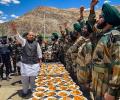
Defence Minister Rajnath Singh on Monday said India is a peace-loving nation that never resorts to any kind of aggression but is always prepared to give a befitting reply if provoked or threatened.

'In Eastern Ladakh the Chinese attempted salami slicing.' 'Our response has been superb. Our military has responded magnificently.'
The MEA spokesperson did not reply to questions like whether the US had approached India with the offer, whether New Delhi has communicated its response over it to Washington, DC or whether the Trump administration has been briefed about the current standoff between Chinese and Indian soldiers in eastern Ladakh.
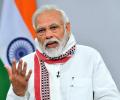
The military brass is learnt to have apprised Modi about the evolving situation in eastern Ladakh, though officials maintained that the agenda of the pre-scheduled meeting was to discuss the ambitious military reforms and ways to boost India's combat prowess.

The shelters were installed in locations near Tashigong, Manza, Hot Springs and Churup among others, in reflection of simmering tensions between the two sides in the region.
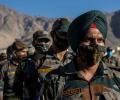
In a strong response to China's objection to development of infrastructure on the Indian side of the LAC, New Delhi also asserted that Beijing has no locus standi to comment on India's internal matters.

Chinese Foreign Minister Wang Yi has expressed readiness to join hands with India's National Security Advisor Ajit Doval to "properly handle" issues related to the situation on the ground in the border areas, amid the protracted border row in eastern Ladakh.

It took India and the Indian Army to show to the world that enough is enough and to challenge the neighbourhood bully, he said.
The two countries reviewed the situation in the region during a fresh round of online diplomatic talks under the framework of the Working Mechanism for Consultation and Coordination (WMCC) on border affairs.
